Showing posts with label film. Show all posts

Saturday, 4 July 2009

Misery business


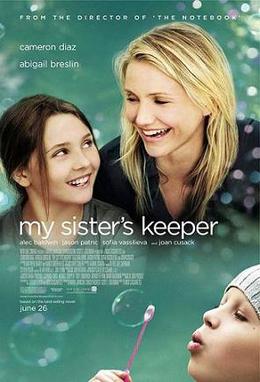
I have always had a somewhat uneasy relationship with book-to-film adaptations. I'm a massive bookworm, so it's perhaps little surprise that I find myself unable to 'let go' of a book I love and take in a film adaptation on its own merit. I was quite excited, though, when I found out there was going to be a film of Jodi Picoult's My Sister's Keeper; I really did think that it could make an interesting premise for a film.

Ah, if only that heady optimism could have carried into the film itself. Within 10 minutes of the opening credits, I had seen young Kate with a profusely bleeding nose and vomiting blood, and had realised that this was very much not the film for me. I didn't want to be there; I continued not wanting to be there for the remaining 100 minutes until the end credits rolled and someone sat behind me turned to the person beside them and said: "I feel emotionally violated."

It's petty to spin the classic "but it wasn't faithful to the book" line, and indeed, much of the film is faithful to the book. One sister (Kate) has cancer and needs a kidney to save her life. Other sister (Anna) doesn't want to give up her kidney and so sues for medical emancipation. Court case, etc. But the book is very much focussed on said court case. The film is very much focussed on said cancer. I've heard My Sister's Keeper described as 'thought-provoking', but a more accurate phrase might be something to the gist of 'rape of the tear ducts'.

You'll probably cry. But you'll also resent those tears, as you will understand, even as they are being shed, how cynically and calculatedly they have been wrung from your eyes. Misery business indeed. Cancer isn't pretty, and the film doesn't shy from that - but my, it's certainly an unrelenting torrent of cinematic misery. I counted one joke; it was about cancer. There's a fragmentary feel at play, with lots of 'fade to black' moments, but nobody could accuse My Sister's Keeper of ever straying from its goal - it sets out early on its target of tears, and shamelessly and repeatedly goes in directly for the kill.

I was hoping that Abigail Breslin (Anna), after her amusingly sweet performance in Little Miss Sunshine, would at least ensure this would be to my taste, but she had a hopeless task ahead of her - rather than sprinkling sugar, the script pours on syrup. You almost wish that Kate would hurry up and get on with it - and yes, that does make you a bad person.

I've always denounced the Hollywood tradition of neatly tying up tales from books and tarting them up a bit in the cheerfulness stakes. This certainly bucked the trend, and I wished to God it hadn't. That's me shown, then.

Tuesday, 16 June 2009

When the seagulls follow the trawler...


I'm just going to come straight out with it: football doesn't really appeal to me. Barring an oh-so-brief and oh-so-arbitrary childhood flirtation with Liverpool - I think I just liked red, and my older cousins had told me that Manchester United fans were only glory hunters - it has mostly just seemed to me to be a bunch of men in shorts, running up and down after a ball. I could explain to you the offside rule in theory, but not identify it in practice. It's safe to say that the communal bonding aspect of the beautiful game has bypassed me nigh-on entirely.

Good thing, then, that Looking for Eric isn't just a film about football. It is a film about football - and a poignantly nostalgic one at that - but it's also a film about many other things: love, fear, inspiration, hope and (whisper it) redemption. Oh, and Eric Cantona; he's more of a metaphor, though. Inner strength and all that.

The concept is an interesting one. A postman (named Eric, conveniently) is struggling to come to terms with the fact that he's left with nothing, not even the respect of his stepsons. One of whom is harbouring a gun for the local hardman. So he repeatedly hallucinates his hero, Eric Cantona, who helps him to work through it all and get himself back onto his feet.

Having someone, especially someone with as much cultural baggage behind him as Cantona, play a large cameo role - indeed, one which forms the driving force of the entire plot - is always risky. But here Loach pulls it off successfully, incorporating the audience's expectations of the footballer into the screenplay in an arch manner; it's funny, but always manages to fall the right side of ridiculous.

Part of this success also comes from the characterisation of the protagonist. Though ultimately flawed, Eric Bishop is easy to empathise with; he's both heartbroken and heartbreakingly human. Steve Evets occasionally plays him a little flat in tone, but for the most part he's not in the least difficult to emotionally invest in.

This is helped by Loach's realistic filming style, contrasting the absurdity of Cantona as a spiritual guide with the mundanity of everyday Manchester existence. The film's climax, while a little too drawn-out, is the perfect realisation of this - a hundred-odd pseudo-Cantonas storming the palatial house of a tyrannical gang-man in a show of fan solidarity.

Original and emotional, and somehow, incredibly, approaching believable: yet another triumph for Film4 Productions. It'd be hard for even a non-football fan to walk away from Looking for Eric unmoved.


Trailer:

Sunday, 10 May 2009

To boldly go...


I went to see the new Star Trek film last night. It's normally everything I'd avoid in a film - I'm not generally a fan of sci-fi, couldn't care less about Lost and tend to think that if a film is genuinely good, it's able to carry itself without the need for excessive big-budget special effects. But back in November I saw a preview of some of the footage for Quench and wrote an article about it (available here). After knowing a fairly large chunk of the storyline, I had to see the film properly, simply to quell my curiosity.

I was surprised to say that I was moderately impressed with the film. It's probably not something that I'd watch again (because the film most likely wouldn't work properly on anything smaller than a cinema screen, if nothing else) and it doesn't do anything new within the sci-f genre, but what it does, it does well.

One of the most impressive things about Star Trek is how good the aesthetic is. It's simultaneously retro and modern, and colour is used really well. It looks sleek, and there are some incredibly stylish shots in it, particularly during the action scenes. And it's all set to a satisfyingly epic score.

Zachary Quinto is great, too; Spock could easily have been hammed-up or stonily monotonous, but Quinto manages to fall into neither extreme, instead playing the character in as convincing a way as is possible. Considering that Spock is an alien. Who meets his time-travelling older self who's come back from the future. And who is played by Leonard Nimoy.

That, actually, is one of the best aspects of the film: it's incredibly knowing, accepting the weight of the franchise that it succeeds and recognising that it will never escape it. It's arch, and funny in a manner which at times even approaches irony. It cracks out all of the classic, clichéd Star Trek lines, but manages to raise a laugh in doing so.

There could be more laughs, though. Simon Pegg is criminally under-used here. The man is a comedy legend; you'd think that if you'd managed to get him on board, you'd want to make a bit more of his part. As it is, he's a minor character, always vying for a little bit more attention than he's ever granted.

There's also a lot of the obligatory morality stuff, and the usual side-story about making a dead person proud. Not that you'd realise that Kirk's father was dead, because it's not mentioned at all. Well, not aside from a massively over-dramatic opening scene featuring baby Kirk being born as his mother is snatched from the jaws of death thanks to his father's courage and sacrifice. Completely overblown and slightly unnecessary.

Also a little overblown but rather more necessary is the plot. There's a lot of time travel; it all gets a bit Doctor Who? from time to time. It's one of those storylines that you can follow as long as you don't pay too close attention to it. It all ties up very neatly, though, and I guess that plausibility isn't an issue when you're setting a movie in space.

Overall, it's enjoyable. It's a semi-riveting way to spend two hours, and require no former Trekkie knowledge to understand. Think of it as Star Trek for beginners. It's hardly reinventing the wheel - or the spaceship, for that matter - but it does seem like JJ Abrams did good here.


Trailer:

Thursday, 26 February 2009

Slumdog's successes

A few weeks ago, I finally saw Slumdog Millionaire. A little overdue, perhaps, but late is always better than never. Well, most of the time, anyway. Long before I actually watched it, though, I read an article on The Times' website denouncing the film as "poverty porn": an article which has played on my mind at multiple points since then.

In case you're interested, the article can be found here.

Well, it might be a bit harsh to say that the article denounces the film; it does acknowledge the merits of the film's cinematography and setting. But, ultimately, Alice Miles comes to the conclusion that Slumdog is a "vile" film. After all, there's so much violence in it.

Yes, it is a violent film. This doesn't exactly mark the film as unique: it's almost rare to see a film without some facet of violence in this day and age. I do share Miles' surprise over the film's 15 rating, but that's a minor point. Scenes of blinding and immolation don't make for comfortable viewing for me, for perhaps obvious reasons, but I can stomach them when they add something to a film's plot.

And that's just the point: these scenes are evidently meant to be uncomfortable to watch. While Miles claims that the film approaches "a form of pornographic voyeurism", I'm personally left wondering exactly what about this is pornographic.

If this is pornography, surely the viewer should be taking some sort of pleasure, sexual or otherwise, from this? Wincing in shock does not, as far as I'm concerned, constitute pleasure. Overall, the film does carry a hopeful theme, but this is despite this "voyeurism" - because of a triumph over this - not as a result of it. Yes, there is a happy ending, but what else was Miles expecting?

Perhaps Miles wanted an equally violent ending. It might have been potentially more realistic, but would no doubt have attracted as much - if not more - criticism. To follow a depiction of Mumbai's slums and the horrors they hold with a hopeless ending could have been seen as simply promoting the view that nobody can ever escape from the slums; once a slumdog, always a slumdog. The film succeeds precisely because of the audacious sense of hope it manages to convey.

Tackling topics like slum life and its violence will never be easy; it's simply not something that we will ever want to accept the reality of. But it's important that people like Danny Boyle continue to face the challenge in creative and original ways; not to do so is tantamount to sweeping a massive social problem under the carpet.

The CEO of the Indian branch of Save the Children has asserted that acts like this are carried out in real life; this is real, so we do need to face upto it. Alice Miles may see Slumdog Millionaire as revealing more of our society's dark underbelly than it does of India's, but for a film like this not to have been made would have shown one hell of a lot more.


E.